

In order to understand masks we must talk about aerosols and droplets.
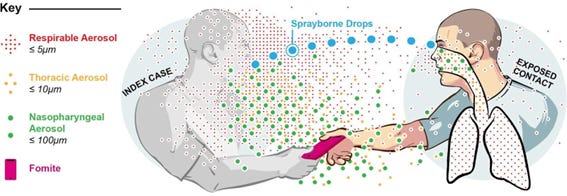
Figure: schematic representation of the droplet (blue) and aerosol (green, yellow, and red) infection pathways for a respiratory disease. Both travel through the air from the infected person to the susceptible person, but ballistic droplets infect by impact, and aerosols infect by inhalation. From Milton (2020), modified by the author (pers. comm.).
1. The “aerosol” path. Aerosols are also particles of saliva or respiratory fluid, but they are smaller than about 100 μm. For this reason they can linger more in the air, from tens of seconds to hours, and the smaller ones can travel long distances. They infect by being inhaled through the nose or mouth, or (less likely) by deposition on the eyes. They reach different parts of the human respiratory tract depending on their size. These are the green, yellow, and red dots in the figure below.
2. The “large droplet” or “ballistic droplet” path. Droplets are particles of saliva or respiratory fluid (larger than about 100 μm, with 1 μm = a millionth of a meter) that are expelled from infected individuals when coughing, sneezing, and to a lesser extent, talking. They fly ballistically (like a projectile) through the air, as in the famous “angry birds” video game. They infect by impacting on the mouth, nostrils, or eyes. They are the light blue ballistic droplets in the figure above. If they don’t hit someone, they fall to the ground in 1-2 m (3-6 ft).
3. The “fomite” path, through touching a surface that is contaminated with the SARS-CoV-2 virus, such as a light switch, a door handle, or someone else’s hand. That can transfer the virus onto your hand, and then you can infect yourself by touching your mouth, nostrils, or eyes.
• Airborne pathogens should be visualized like cigarette smoke. Only then can we truly understand that masks not only work, but air quality, ventilation, and the use of fans and purifiers (which literally remove airborne pathogens) are key.
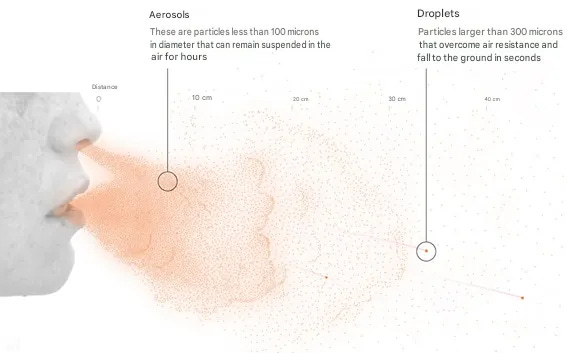
Some examples of airborne pathogens are: Chicken Pox, COVID-19, Long COVID, Influenza, Measles, Mumps, Common Cold, Rubella, Bronchiolitis, Smallpox, Whooping Cough, Diphtheria, Legionella, Meningitis, Tuberculosis and Aspergillosis.
In some cases such as Hantavirus, COVID and Avian Flu, droplets are another form of transmission.
The problem is that when a disease is transmitted through aerosols and droplets, governments will ignore the former and only talk about the latter. This decision isn’t based on science, but on prioritizing the capitalist economy. Airborne infections require more widespread care, more attention, and therefore more money.
Here is a more detailed explanation about airborne pathogens:

So how do masks work?
The Multiplicative Power of Masks
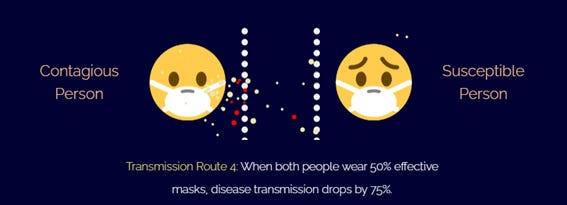
When both people wear 50% effective masks, disease transmission drops by 75%.
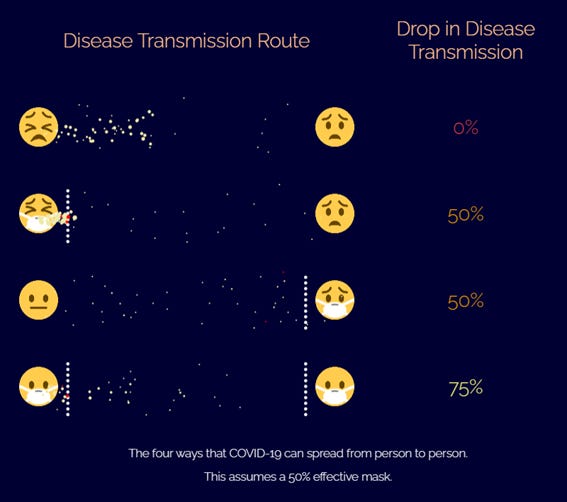
If you think about it, it’s surprising that a 50% effective mask can reduce the risk of infection by 75%. This is possible because when both people wear masks, the chance of infection is halved twice. This double protection makes masks much more effective than you might intuitively expect.
The four ways that COVID-19 can spread from person to person. This assumes a 50% effective mask:
Masks, like much of public health, is a collective action and shared responsibility. In societies where collective mask wearing is not established, people often do not want to stand out and wear a mask. But many, many people would wear masks if they knew that the majority would be wearing them too; In this case, people can get superior protection and do not risk standing out.
Our governments have given confusing messages about the use of masks, even outright discouraging it. We believe there should be widespread support from our governments, pro-mask campaigns and education, and free and affordable availability of quality masks. We still hope that these are actions taken in the future, but the failure of governments has left the responsibility on us. The good news is that each person who wears a mask has an impact on reducing transmission that is bigger than themselves.
The more interactions that contain masks, the better! So let’s do what we can to encourage mask-wearing and make it accessible. Every mask used has an impact! Masks work!
For a mask to work there are 2 things to take into account:
1) Filter quality
2) The airtight seal of the mask
The quality of the filter has to do with the percentage of protection it gives, and the seal is what makes it work. If you use a good quality glove but it has a hole, the quality of the glove takes a backseat. The same goes for masks, they must have a good seal, which means no leaks on the sides.
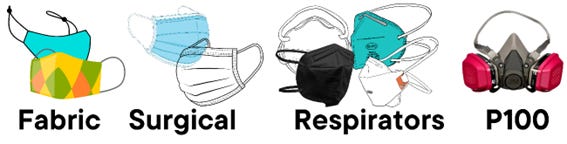
There are 4 types of masks:
1. Fabric
2. Surgical
3. Respirators
4.P100
Any mask is better than none, but understanding the basic science of how respirators work to protect you can help you understand why quality is so important.
1) Fabric: only protect droplets NOT aerosols
2) Surgical: they usually have 3 layers, they protect against droplets and aerosols but because they are very large they create enormous leaks and their effectiveness is low; Maximum safe use is around 3-4 hours
3) Respirators: they usually have 5 layers, they protect from droplets and aerosols; They can be used for a maximum of 25 hours (not all in a row). There are two things that are special about respirators. First, they create an airtight seal around your mouth and nose. Second, they have a static charge that attracts small particles and filters them effectively. Surgical masks have some of that static charge and filter out some particles, but they don’t create a seal. Cloth masks do not have this charge and do not have a good seal either. By filtering aerosols, respirators also filter pollution, smoke and dust.
Respirators have different names depending on the health regulations of each continent or country:
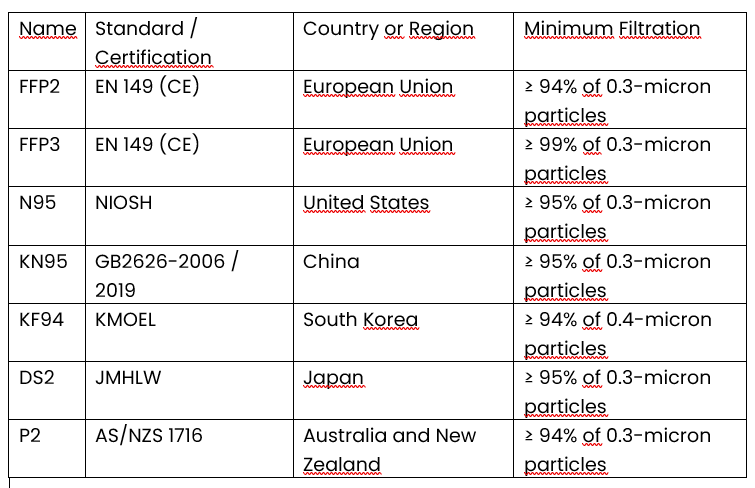
FFP2 = N95 ≈ KN95 ≈ KF94 ≈ P2, with minor technical differences in testing methods and manufacturing requirements.
Counterfeit KN95 respirators are fairly common. A genuine KN95 respirator should be marked with “GB2626-2019.”
KF94 respirators are similar to KN95s, but they are generally less likely to be counterfeited and tend to be slightly more expensive.
In any case, it is always important to verify the authenticity of respirators to avoid counterfeit products.
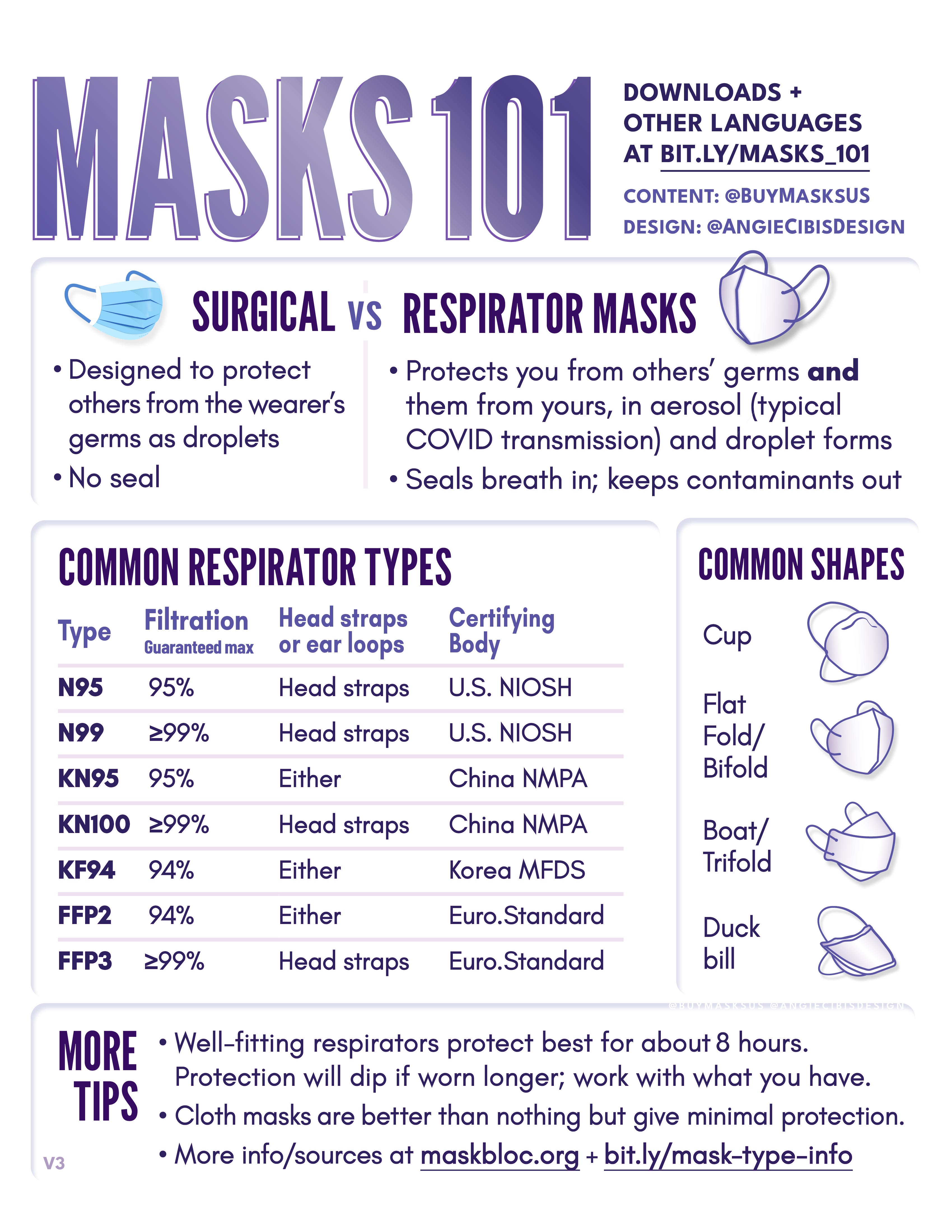
Certified Reusable Masks: It may be discouraging to learn that reusable cloth masks are not effective in protecting us from aerosols, but there are other options to reduce your waste! Several brands make reusable respirators with disposable filters, such as Flo Mask and Envo Mask. These masks are very expensive, but they are designed to be reused and look really cool.
Valved masks release unfiltered exhaled air and increase the risk of contagion if you are sick, so valveless respirators offer better protection for the community.
4) P100: they are the ones that best protect us against fires, tear gas...
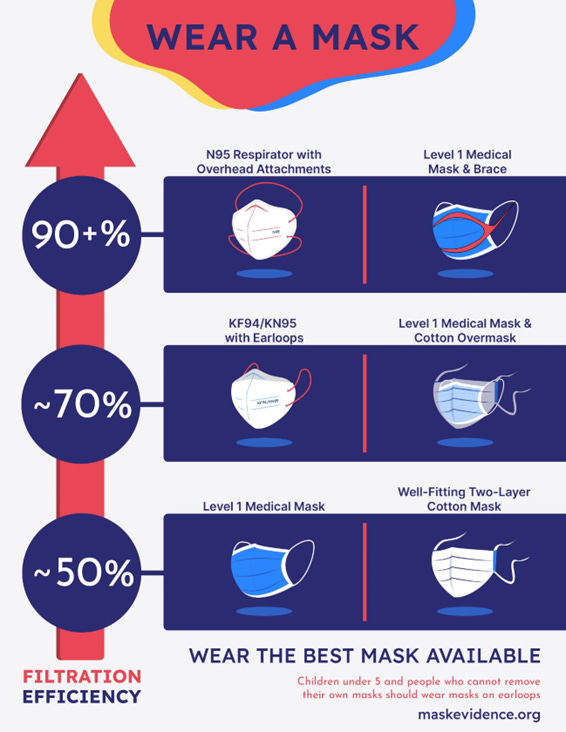
Comparison of use of
1) respirator without adjustment (blue on chart)
2) respirator with adjustment (orange on chart)
3) respirator + surgical (yellow on the graph)
4) respirator adding adhesive tape (purple in the graph)
5) surgical (green on the graph)

Cloth masks don’t offer very much protection at all.
Respirators provide the best protection against Covid, and they work against all variants.
There’s vast differences in inward mask leakage between N95s and other masks (and remember: leakage is what we’re trying to avoid):
· Fabric 70%
· Surgical 44.2%
· KN95 16.1%
· N95: only 0.6% (this is why they’re the safest!)
Sample leak graph:
It only takes a very small amount of viral aerosol to cause an infection, which is why respirators are the best masks for preventing infection because they filter the air best and offer the best seal.
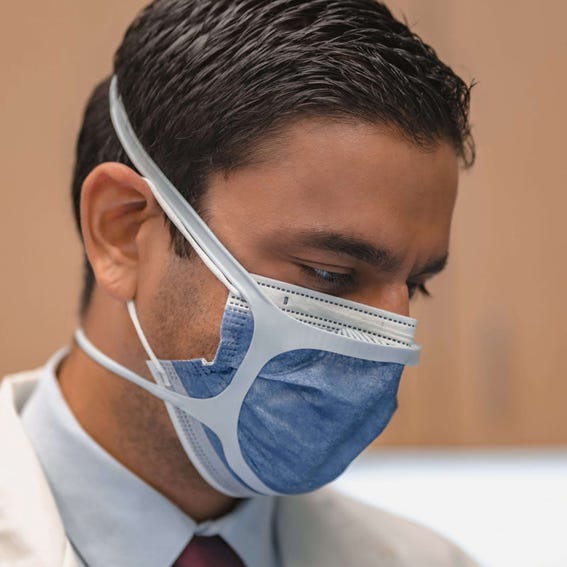
Adding a head strap (like this one) to KNP95 (OR FPP2) earloop masks can make them fit more like an NP95 (OR FPP2). It helps create a tighter seal and also takes pressure off your ears.
What does the airtight seal have to do with masks?
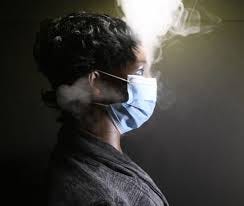
When it is winter and you breathe and see a white color of some kind of smoke, those are your aerosols; we propagate them continuously. They move like smoke and can remain there for hours. Can’t you smell the cigarette smoke of a person smoking 5 meters away from you? The same thing happens with aerosols.
While a surgical mask can physically block airborne particles that can cause other diseases, without that seal around your face, you’d likely still breathe COVID (and other airborne diseases) if you’re exposed, and you’d be spreading it to others if you have it.
To wear a mask correctly, it is important to keep some tips in mind:
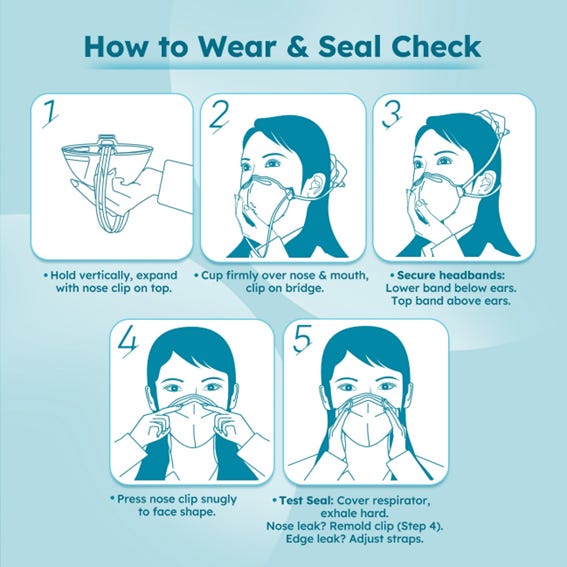
1. About “V” shaped masks
The wire of the mask can be adjusted to your face! As you can see, there are many masks that have a wire that forms a V that leaves a leak!
To give them the correct shape, unfold the mask completely and put it on by pressing with both hands.
Few noses are that shape so to adapt it to your nose, you flatten the wire with your fingers and then you can give it the shape you need.
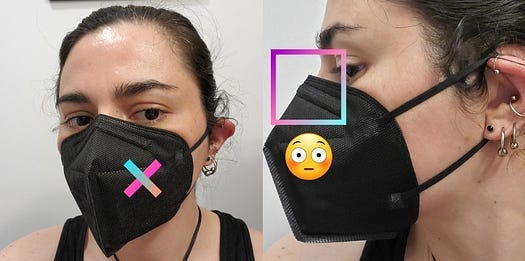
Selfie of Sharyn Blum in three-quarter view. I am a white person with dark eyes, dark hair pulled back away from my face, and a lot of earrings. I’m wearing a black tank top and a black KN95 mask with a very obvious cleanly folded line down the middle from the top of my nose to the seam in the front of the mask. A colorful X icon has been pasted in over the left cheek of the mask. Photo 2: Selfie of me just as in the last image, but now in profile. A colorful square has framed the top of the mask over the nose bridge, showing nearly a quarter inch of gap between my nose and the the mask. A flustered blushing face emoji is pasted under the square.
This video of Sharyn Blum shows you step by step:
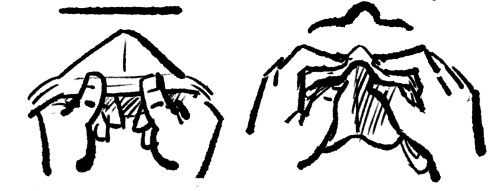
Drawing of Hazel Newlevant
Here you can see the difference:
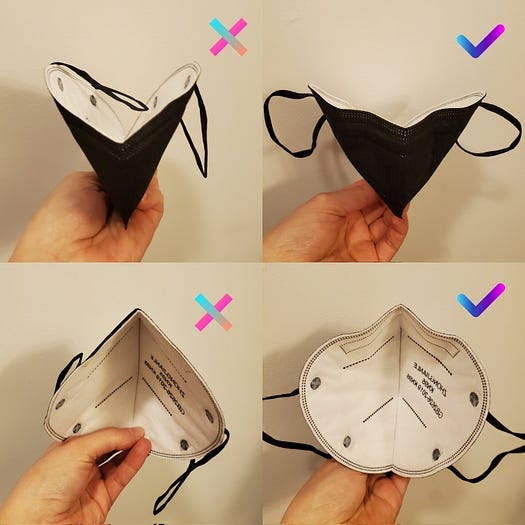
Photo de Sharyn Blum. Photo 1: A black KN95 viewed from the top down while held up in my left hand against a white wall. It’s been slightly opened and has a clear V-shaped crease in the nose wire. A colorful X icon has been pasted in the top right corner of the photo. Photo 2: Same black KN95 viewed from the top down, but this time it’s been shaped. It’s holding a natural open without any additional effort and it has a gentle, double S curve shape in the nose wire, which meets at the middle in a sharper curve. A colorful checkmark icon has been pasted in the top right corner of the photo. Photo 3: Same black KN95 as in first photo, but now held up facing into the white interior of the mask. Again, there is a clear V-shaped crease in the nose wire. A colorful X icon has been pasted in the top right corner of the photo. Photo 4: Same black KN95 as in second photo, but now held up facing into the white interior of the mask. Again, the curves are plainly visible and clearly resemble the natural shape of a face across the upper nose and cheekbones. A colorful checkmark icon has been pasted in the top right corner of the photo.
2. Support for adjusting the mask
If the mask is a little big, you can do several things:
a) Use double-sided adhesive tape on the inside of the mask, in areas where you need a better seal.
b) Use normal adhesive tape to secure the mask from the outside to the facial skin.
c) Adding a head strap. (like this one) to KNP95 (OR FPP2) earloop masks can make them fit more like an NP95 (OR FPP2). It helps create a tighter seal and also takes pressure off your ears.
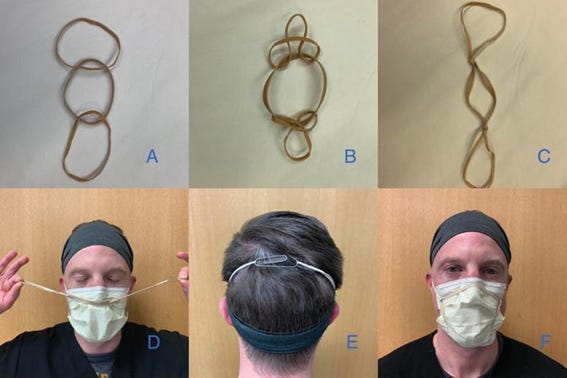
d) Use elastic bands to adjust it better to the face. There are commercial devices designed for this purpose, or you can make a homemade one using elastic bands.
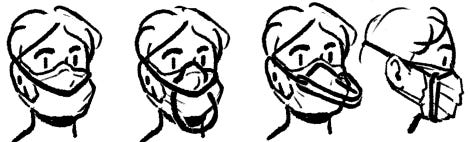
Drawing of Hazel Newlevant
3. Checking the fit of the mask
Place your hands around the mask, covering areas where air could enter or leave, and exhale forcefully.
If you notice air escaping around the edges, it means the fit is not correct.
“I can’t find a mask that fits my face!”
· N95 masks are the American standard and were primarily designed to fit the faces of white men working in industrial jobs, so it’s not uncommon to find difficulty getting a good seal. The best mask is one that fits. Try a KN95 (Chinese standard) or KF94 (South Korean standard) for a different fit and read this for further information.
· It’s possible to staple 3M Aura masks at the chin (as demonstrated by Alex here) for a tighter fit, and this hack has successfully passed fit tests.
· If you’re an adult with a smaller face, a good bifold option is the M95 mask by Lutema
· Mask braces can be a good option to ensure a tighter fit
· Check out the excellent videos made by Lola Germs to learn more about mask fit!
· Some companies make variety packs of masks so you can try a bunch and see what works for you
· Medical tape can help secure your mask to your face and ensure a good seal
· Adhesive foam can be bought online and applied to the inside of your mask to improve the fit
· IMPORTANT GUIDE TO FITTING BIFOLD MASKS HERE
· Make sure they know how to correctly wear a respirator! This link has a guide.
N95 sizing tips
· 3M Auras are a comfortable, widely-available respirator option, and they fit most people’s faces well. Start by trying these. If the 3M Aura is too big, try the CAN99, then the VFlex small. If the 3M Aura is too small, we recommend the VFlex regular.
Ultimately, the best mask for you is one that you will wear.
Some masks are really uncomfortable!
If you try a respirator and find it unbearably uncomfortable, so much so that you constantly take it off or play with it, breaking the seal, it is not the right choice for you. There’s no shame in trying something that doesn’t work, but our collective health is worth it.
Masks can be uncomfortable, like a seat belt or a condom, but that does not mean that we do not use them, but rather that we look for those that are best for us. Wearing a mask doesn’t have to make you miserable, there are mask geeks like me who will be happy to listen to you and advise you. The neurodivergent community turned to me to make a list of recommendations, there are more people like me who want you to protect yourself comfortably. And remember: social activism is also uncomfortable, but that doesn’t mean we stop moving, we wear a mask not for individual reasons, but for collective commitment. Your health is our health
if your glasses are always fogging up:
Here’s a guide that troubleshoots foggy glasses from masks
Help them make sure their mask fits and has a nosewire
Offer to give them some anti-fog lens wipes (or lens cleaner)
If your skin breaks out:
Using antiseptic mouthwash before putting on your mask might actually help prevent breakouts
Skipping makeup and sunscreen under masks helps a lot
Wear a clean mask
Pimple patches can be worn under masks (no one will see them!)
Washing your face before and after putting on a mask seems to help a lot!
If you have a beard:
Send them this video, which has instructions on how to wear a beard cover under their masks: “Beard Cover Technique—Elastic Band“
“I don’t want to wear a mask because I’m wearing a formal outfit / I don’t want to mask because it’s not stylish.”
Fashionable mask options exist! If you’re looking for a fancier mask option, check these out:
masklab makes gorgeous masks (in adult and children’s sizes)
Private Stock Labs sells fancy KN95s in a wide range of colors (and in multiple sizes)
wellbefore sells KN95s (with nose foam!) in a wide range of colors
Benehal and BNX both sell black head strap N95s
Canada Strong Masks sells a wide variety of masks in different colors
Masks are an extra accessory, and you can absolutely find one that works with your outfit!
If you want to know more about electrostatic charge: Let’s talk about the Physics of Masks
Written by @covidsafecolorado
“How does an electrostatic charge work? Which masks have it? What are Elastomeric Respirators? (See the following slides to find out more)
The fibers of cloth or surgical masks filter particles by physically blocking them, but the fibers of an N95 mask use a great physics trick. N95s are designed for particles to stick to woven fibers. These fibers are electrically charged.
Plastic fibers carry an electrostatic charge that attracts passing particles, like a magnet. This means that particles in the air carrying viruses, dust, paint or other toxic materials remain trapped in the mask and are not inhaled.
The fibers of the mask are made of an “electron” material, a permanently electrically charged object. Other types of respirators may use electrostatic filters, such as Elastomeric Respirators. What are Elastomeric Respirators?
1. Sealed respirators made from synthetic or natural rubber materials.
2. They can be reused, disinfected, stored and reused.
3. Equip yourself with replaceable filter cartridges or flexible disc or pancake style filters.
4. They may also have sealing surfaces and adjustable straps for a better fit
Sources:
The science behind masks and their use - by Bill Comeau
FAQs on Protecting Yourself from Aerosol Transmission - Google Docs
angiecibis Official: Instagram | Linktree
The Difference Between KF94 and KN95 Masks, Explained | The Strategist
How Does an N95 Respirator Work? It’s All in the (Very Small) Details
How well do face masks protect against COVID-19? - Mayo Clinic
Effectiveness of N95 Mask in Preventing COVID-19 Transmission - PMC
Elastomeric respirators are safer and more sustainable alternatives to disposable N95 masks during the coronavirus outbreak | International Journal of Emergency Medicine | Full Text
Elastomeric Respirators - Clean Air Crew
Elastomeric Respirator Resources | NIOSH | CDC